 listicle
Common Plumbing Issues in Older Homes
Table of Contents
- Why Older Homes Have More Plumbing Problems
- Galvanized Pipes in Old Houses: Corrosion and Deterioration
- Lead Pipes in Older Homes: Health and Safety Concerns
- Low Water Pressure in Old House: Causes and Solutions
- Leaks, Clogs, and Failing Sewer Lines
- Old Plumbing Pipe Replacement: Repair vs. Repiping
- DIY Checks and When to Call a Professional
- Frequently Asked Questions
Last Updated: October 21, 2026
Why Older Homes Have More Plumbing Problems
Older homes weren't built for today's water demands. A 1950 family of four used far less water: short showers, weekly laundry, no dishwashers.
The pipes installed decades ago are still there, stressed by usage they were never designed for. Add mineral deposits, corrosion, and shifting foundations, and failure is likely. At Handy Horrigan LLC, we've diagnosed plumbing issues in hundreds of older homes across southwest Ohio: the further back you go, the more likely serious problems become.
Common plumbing issues in older homes fall into predictable categories: material failures (corroding galvanized steel, lead, deteriorating cast iron) and age-related wear (leaks, low pressure, slow drains, failing sewer lines). Understanding what's behind your walls helps you decide whether to repair or replace.
Galvanized Pipes in Old Houses: Corrosion and Deterioration
Galvanized pipes dominated residential construction from the 1950s through the 1980s. The steel was zinc-coated to resist rust, but the coating eventually fails.
Galvanized pipes typically last 40-50 years before corrosion becomes serious. If your home was built between 1960 and 1980, they're likely failing or failed.
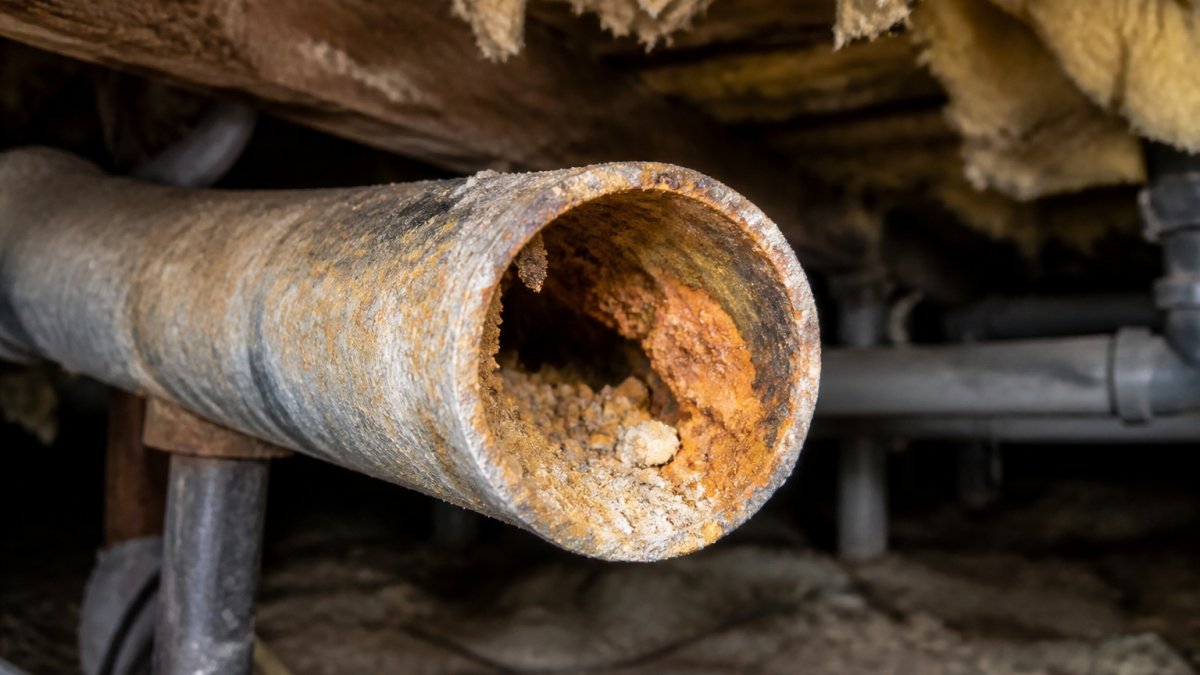
The real problem isn't appearance. As corrosion thickens, pressure drops and fixtures starve for flow. Worst case: the pipe ruptures inside a wall, unnoticed until water damage appears.
A common mistake is treating galvanized corrosion as a localized repair.
Lead Pipes in Older Homes: Health and Safety Concerns
Lead pipes were common in homes built before 1950, and lead solder was standard in copper systems through the 1980s. Lead doesn't rust or corrode visibly, which is why it was popular. The problem is invisible: lead leaches into drinking water, especially in acidic systems or when water sits overnight.
Lead exposure poses serious health risks, particularly for children and pregnant women. According to EPA guidance on lead and drinking water, even low levels of lead exposure can affect child development and learning. There is no safe level.
How to identify possible lead plumbing
Visual inspection can only suggest a possibility, not confirm it. Check these clues:
- Service line material. Find where the water line enters your home, usually in the basement or crawlspace. Lead pipe is soft, dull gray, and easily scratched with a key, revealing a shiny silver color underneath. Copper is reddish-brown and hard. Galvanized steel is gray and magnetic.
- Solder joints. In copper systems, lead solder looks dull gray and lumpy at joints. Lead-free solder is typically brighter and smoother.
- Home age. If your home was built before 1950, assume lead pipes or lead solder may be present. If it was built between 1950 and 1988, lead solder is still possible.
- Water authority records. Many municipal water systems maintain records of service line materials. Call your local water authority and ask whether your address has a known lead service line.
Testing your water
A simple test kit costs under $20 and takes a few days. For more reliable results, use a certified laboratory; the EPA maintains a list, and your water authority can recommend one.
Steps to take if lead is suspected
- Stop using the tap for drinking and cooking until you have test results. Use bottled water or a certified filter.
- Flush the line before drinking. Run cold water for several minutes, especially after periods of non-use. Never use hot water for drinking or cooking, because hot water dissolves lead more readily.
- Contact your local water authority about testing programs, service line records, and any financial assistance for replacement. Many municipalities now offer programs to help homeowners replace lead service lines.
- Have the line replaced professionally. This is not a repair, it's a replacement. The process requires careful handling to avoid contaminating your soil.
Lead service lines are a public health issue. Many municipalities now offer programs to help homeowners replace them. Check with your local water authority about assistance programs before paying out of pocket.
Low Water Pressure in Old House: Causes and Solutions
Low water pressure in an older home usually points to mineral buildup inside old pipes, corroded galvanized pipes narrowing the passage, or failing municipal supply lines.
Start with a simple check. Turn on a faucet and observe the flow. Is it weak everywhere in the house, or only in certain fixtures? If it's weak everywhere, the problem is likely upstream, either your main line or the municipal supply.
Mineral buildup is common in older homes with hard water. Calcium and magnesium deposits accumulate over decades, narrowing the passage and restricting flow. You can clean aerators and showerheads with vinegar, but not the inside of pipes.
Low pressure combined with discolored water almost always means galvanized pipe corrosion. The rust buildup is blocking flow. At this point, repair is temporary. Replacement is the only permanent fix.
Leaks, Clogs, and Failing Sewer Lines
Leaks in older homes take three forms: slow drips at joints, visible water damage in walls or ceilings, and hidden leaks inside walls or under foundations.
Slow drips at joints are easiest to spot and address: a leaking faucet or sweating joint can usually be tightened or resealed. Visible water damage signals a more serious leak.
Slow or clogged drains plague older homes for two reasons: tree roots invading sewer lines and decades of buildup.
A single clog is a nuisance. Repeated clogs in the same drain signal a deeper problem, likely a failing sewer line.
Sewer camera inspection is the diagnostic tool. A professional feeds a camera through your line and shows you exactly what's happening: cracks, root intrusion, bellies (sagging sections), or complete collapse. The cost of inspection is modest compared to the cost of guessing wrong.
If multiple fixtures drain slowly or back up simultaneously, the problem is in the main sewer line, not individual drains. This requires professional diagnosis. Do not use chemical drain cleaners, they damage old pipes and do not solve sewer line problems.
Old Plumbing Pipe Replacement: Repair vs. Repiping
The decision to repair or replace hinges on the age of your plumbing, the extent of the damage, and your long-term plans.
A decision framework
Use these questions to guide the conversation with a plumbing professional:
- How many failures have you had in the past two years? One isolated failure in a system that is otherwise sound points to repair. Two or more failures in different locations suggest the system is deteriorating as a whole.
- Where are the failures? A single leak at a fixture or a short section of pipe is usually repairable. Failures in walls, under slabs, or in multiple rooms indicate systemic problems.
- What is the pipe material? Galvanized steel that is 40-50 years old is at the end of its service life. Copper can last 50-70 years but may fail at joints. Polybutylene, used from the late 1970s to the mid-1990s, is prone to sudden failure and is often best replaced entirely. Lead service lines should be replaced for health reasons.
- Is water pressure or water quality affected? Widespread low pressure or discolored water usually means corrosion or buildup throughout the system, which repair cannot fix.
- Are you planning a major renovation? If walls will be open anyway, repiping is more cost-effective because the access work is already being done.
Repair: when it makes sense
Repair suits isolated problems in relatively young systems. A burst copper pipe, a failed valve, or a single corroded section is fixable without replacing the whole system.
Repiping: when it is the better investment
Repiping means replacing all or most of the water supply lines. It's invasive, expensive, and disruptive, with walls opened and floors cut.
Here's the reality: if your home is 60+ years old and still has original galvanized pipes, you're living on borrowed time. Every repair buys you a few more months or years. Repiping buys you decades.
What to expect during repiping
A whole-house repipe involves opening walls at fixture locations and running new lines, often copper or PEX.
| Scenario | Best Approach | Why |
|---|---|---|
| Single burst copper pipe | Repair | Isolated damage in a sound system |
| Widespread galvanized corrosion | Replace | System-wide failure is inevitable |
| Low pressure + discolored water | Replace | Corrosion is advanced throughout |
| Lead service line | Replace | Health risk cannot be repaired |
| Isolated slow drain | Repair | Problem is localized, not systemic |
| Multiple simultaneous issues | Replace | Multiple failures signal system-wide age |
DIY Checks and When to Call a Professional
You can diagnose some plumbing problems yourself. You cannot fix all of them.
DIY checks you can do:
Check water pressure with an inexpensive gauge (under $15) on an outdoor faucet. Normal is 40-80 PSI; below 40 signals a problem.
Inspect visible pipes in your basement or crawlspace for rust, discoloration, or corrosion, and look for water stains on ceilings or walls, which indicate leaks.
Test your water for lead and other contaminants with kits from hardware stores or your local health department.
Listen for running water when no fixtures are on. This signals a hidden leak.
When to call a professional:
If water is discolored or tastes off, have it tested by a professional lab, not just a DIY kit.
According to National Association of Home Inspectors standards, plumbing systems in homes over 40 years old should be inspected by a licensed professional every 2-3 years.
Common plumbing issues in older homes are predictable and manageable if caught early.
Handy Horrigan LLC has helped hundreds of homeowners in southwest Ohio navigate these decisions.
Frequently Asked Questions
What type of plumbing do old houses have that's bad?
Older homes typically contain galvanized steel, cast-iron, or lead pipes. Galvanized pipes corrode over 50-75 years, restricting water flow and causing discoloration. Cast-iron drain lines develop cracks and collapse. Lead service lines pose serious health risks, especially to children and pregnant women. Polybutylene pipes, common in 1970s-1990s homes, become brittle and leak. Copper pipes, while durable, can corrode if water is acidic. A professional plumbing inspection can identify which materials are in your home and their condition.
Why do older homes have low water pressure in an old house?
Low water pressure in older homes stems from mineral buildup inside galvanized or cast-iron pipes, corroded fixtures, or undersized supply lines installed decades ago. Sediment accumulates as pipes deteriorate, narrowing the passage for water. Failing pressure regulators or leaks elsewhere in the system also reduce flow. A plumber can test pressure at different fixtures and use a camera inspection to identify blockages. If pressure is consistently low throughout the home, repiping may be the most effective long-term solution.
How can I tell if the pipes in an older home need replacing?
Signs include discolored or rusty water, frequent leaks, slow drains, low water pressure, and visible corrosion on exposed pipes. If your home is over 50 years old and has galvanized pipes, or over 30 years old with polybutylene lines, replacement is often necessary. Bubbling ceilings or walls, sewer odors, and backed-up drains indicate failing drain lines or sewer damage. A professional plumbing inspection with a sewer camera can assess pipe integrity and help you decide between targeted repairs and full repiping.
What is the average life expectancy of house plumbing pipes?
Galvanized steel pipes last 50-75 years before significant corrosion occurs. Cast-iron drain lines typically fail after 75-100 years. Copper pipes can last 50+ years but may corrode in acidic water. Polybutylene supply lines last 25-40 years. PVC drain pipes last 50+ years. Lead service lines, installed before 1986, pose ongoing health risks regardless of age. If your home was built before 1980 and still has original galvanized or cast-iron plumbing, a professional inspection is advisable to assess remaining lifespan and plan replacement.