 how-to
How to Fix Tripping Circuit Breakers: A Safe Guide
Table of Contents
- What Causes a Circuit Breaker to Trip
- How to Reset a Tripped Circuit Breaker Safely
- Circuit Breaker Keeps Tripping With Nothing Plugged In
- Recognizing Circuit Breaker Overload Symptoms
- When to Call an Electrician for a Tripping Breaker
- Common Mistakes to Avoid When Troubleshooting
- Frequently Asked Questions
Last Updated: October 18, 2026
What Causes a Circuit Breaker to Trip
When you experience tripping circuit breakers, your home's safety system is doing its job, cutting power to protect your wiring from overheating and catching fire. Understanding what triggers the trip is the first step toward fixing it safely.
Most tripped breakers fall into a few clear categories, and knowing which one you're dealing with tells you whether to reset it yourself or call a professional.
Overloaded Circuits
An overloaded circuit happens when too many high-wattage appliances run at once on one circuit. Each circuit has a power limit, and exceeding it trips the breaker as a safety measure.
Common culprits include:
- Running a microwave, toaster, and coffee maker simultaneously
- Using multiple space heaters on the same circuit
- Charging several devices while running a hair dryer
- Operating a washing machine and dryer together
The solution is simple: spread high-power devices across different circuits and unplug one before plugging in another.
Short Circuits and Ground Faults
A short circuit occurs when a hot wire touches a neutral wire or ground, creating a massive current surge that trips the breaker instantly. A ground fault is similar but sends current to ground through an unintended path.
These are more serious than overloads. Signs include:
- A burning smell near outlets or appliances
- Visible scorch marks on outlets or plugs
- Sparks when plugging something in
- A breaker that trips immediately after you reset it
Do not ignore these warning signs. Call a licensed electrician right away. Short circuits and ground faults can cause fires if left unchecked.
How to Reset a Tripped Circuit Breaker Safely
Resetting a breaker is straightforward, but safety comes first. Follow these steps exactly to avoid electrical shock or injury.
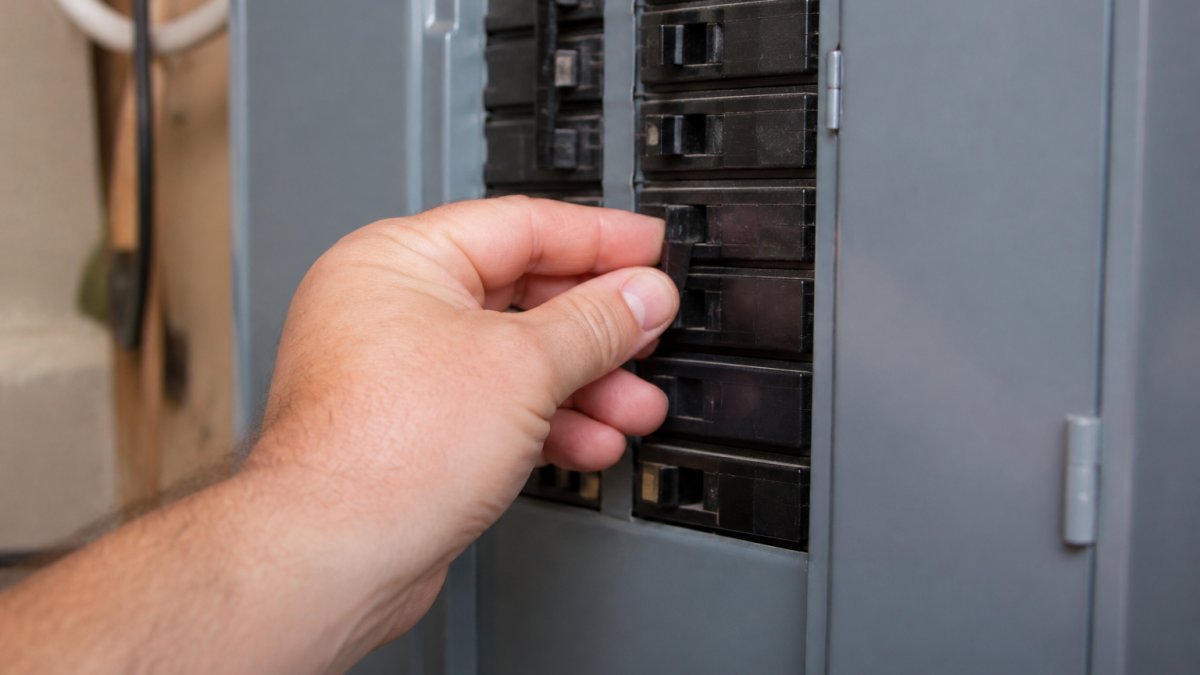
Step-by-Step Reset Process
Step 1: Locate your electrical panel. Find the breaker box, usually in a basement, garage, utility room, or outside wall, and open the door carefully.
Step 2: Identify the tripped breaker. Look for a handle in the middle position or fully to the OFF side; most breakers point to ON when active.
Step 3: Unplug the appliances on that circuit. This prevents the breaker from tripping again immediately.
Step 4: Switch the breaker fully OFF. Push the handle all the way to OFF until it clicks.
Step 5: Switch it back ON. Push the handle to ON until it clicks firmly into place.
Step 6: Test the circuit. Plug in one device at a time. If the breaker holds, you're done; if it trips again immediately, stop and call an electrician.
Safety Precautions Before You Start
Never touch the main breaker or bus bars inside the panel, they carry lethal voltage even when individual breakers are off.
Keep the panel door closed except when actively working, and keep children and pets away.
If the breaker keeps tripping after you reset it, do not reset it again, repeated trips signal a deeper problem that needs professional diagnosis.
Wear dry shoes and avoid wet floors near the panel; moisture increases shock risk.
Circuit Breaker Keeps Tripping With Nothing Plugged In
A breaker that trips with nothing plugged in means the fault is in the wiring, the panel, or the breaker itself, not your appliances. This is where homeowners most often make things worse by resetting repeatedly, so treat it as a stop-and-diagnose situation.
A Safe Diagnostic Flow (No Panel Work Required)
Use this decision tree to gather information for an electrician without opening the panel or removing the cover.
Step 1: Confirm the breaker is actually tripping with no load. Unplug everything on that circuit, including forgotten devices, garage door openers, sump pumps, doorbell transformers, hardwired smoke detectors on a shared circuit, and outdoor outlets.
Step 3: Isolate by switching off other breakers. With the tripped breaker OFF, turn off other branch breakers one at a time and try to reset.
Step 4: Check for moisture. Look for water stains, rust, or corrosion on the panel cover and outlets on the affected circuit; moisture in outdoor outlets, irrigation wiring, or a basement panel commonly causes ground-fault trips.
Step 5: Record what you find. Note the breaker label, trip timing, connected devices, and any recent work (new appliance, storm, plumbing leak). An electrician can diagnose far faster with this log.
What the Pattern Usually Means
| Pattern | Likely Cause | Safe Action |
|---|---|---|
| Trips instantly, every time | Short circuit or ground fault in wiring | Stop resetting; call an electrician |
| Trips after a few minutes | Failing breaker or hidden load | Log timing; call for diagnosis |
| Trips only in wet weather | Moisture in outdoor wiring or outlets | Keep breaker off; call an electrician |
| Trips when HVAC or pump starts | Motor fault or undersized circuit | Have the equipment and circuit evaluated |
| Trips after recent remodeling | Nicked wire or loose connection | Do not reset; call for inspection |
Why You Should Not Keep Resetting
Each reset sends current through a fault the breaker is trying to isolate, bypassing the protection that prevents overheating and fire, which is why repeatedly resetting tripping circuit breakers is dangerous. Electricians commonly report breakers that held through months of repeated resets and then failed closed or welded, leaving the circuit unprotected.
What Not to Do
- Do not open the panel cover to inspect wiring.
- Do not replace the breaker yourself to "see if that fixes it."
- Do not swap in a higher-amperage breaker.
- Do not tape or hold the breaker in the ON position.
A licensed electrician will use a multimeter, insulation tester, and circuit tracer to locate the fault without energizing damaged wiring, usually the fastest path to a safe fix.
Recognizing Circuit Breaker Overload Symptoms
Not every electrical problem trips a breaker. Learning to spot these warning signs helps you catch issues before they become dangerous.
Signs of Excessive Electrical Load
Watch for these indicators that a circuit is working too hard:
- Lights dim when you turn on a major appliance
- Outlets feel warm to the touch
- A buzzing or humming sound near outlets or the panel
- Outlets or switches that spark when you plug something in
- A burning smell near electrical equipment
Any of these means the circuit is stressed. Reduce the load immediately by unplugging devices or spreading usage across circuits.
Prevention Through Load Distribution
The best way to avoid repeated tripping is to manage how you use your circuits. Most homes have 15- or 20-amp circuits; older homes may have 15-amp circuits throughout.
Here's how to distribute your electrical load:
- Identify which outlets connect to which breaker (turn breakers off one at a time to map them)
- Keep high-wattage appliances on separate circuits when possible
- Avoid running multiple heating devices simultaneously
- Stagger charging times for large devices like electric vehicle chargers or battery backup systems
- Use power strips with surge protection, but do not daisy-chain them
An electrician can assess your home's electrical capacity if you frequently experience overloads; older homes especially may need circuit upgrades for modern appliance demands.
When to Call an Electrician for a Tripping Breaker
Knowing when to call a professional protects your home and safety. Some breaker issues are DIY-friendly; others require licensed expertise.
Red Flags That Require Professional Help
Call an electrician immediately if you notice:
- A burning smell or visible scorch marks
- A breaker that trips repeatedly after you reset it
- Sparks coming from outlets or the breaker box
- Breakers that trip with nothing plugged in
- Charred or melted plastic on the breaker or panel
- Water damage near the electrical panel
- Flickering lights throughout the home
- A breaker that feels hot to the touch
These symptoms indicate serious electrical faults. Continuing to use the circuit risks electrical fire or electrocution.
GFCI and AFCI Breaker Behavior
Modern electrical codes require special breakers in certain locations. Here's how they work.
GFCI breakers (Ground Fault Circuit Interrupter) protect against ground faults and are required in bathrooms, kitchens, garages, and outdoor outlets. They trip more easily than standard breakers because they catch small faults before they cause injury, so occasional trips near water are normal.
AFCI breakers (Arc Fault Circuit Interrupter) detect dangerous arcing and are now required in bedrooms and living areas. They sometimes trip during normal operation, especially with older brush-motor appliances, a feature, not a defect.
If your GFCI or AFCI breaker trips regularly, unplug devices one at a time to find the culprit. If a specific appliance causes the trip, it likely has an internal fault and should be replaced or repaired.
Common Mistakes to Avoid When Troubleshooting
Many homeowners make mistakes that worsen the problem or create new hazards. Avoid these:
Mistake 1: Resetting a breaker repeatedly without investigating. Each reset bypasses your safety system; if it trips again, stop and diagnose the cause.
Mistake 2: Assuming all breaker trips are overloads. Some signal dangerous faults; burning smells and sparks require professional attention, not repeated resets.
Mistake 3: Taping a breaker in the ON position. This disables the safety mechanism and creates severe fire and shock hazards.
Mistake 5: Working inside the panel yourself. The main bus bars and connections carry lethal voltage; leave internal work to licensed professionals.
Mistake 6: Overloading circuits with power strips. Plugging multiple high-wattage devices into one outlet through a power strip defeats the circuit's safety limits.
Mistake 7: Replacing a breaker with one rated for higher amperage. This mismatches wire gauge and breaker capacity, increasing fire risk.
Repeated breaker trips are your home's electrical system sending a warning.
At Handy Horrigan LLC, we specialize in diagnosing and resolving electrical issues safely.
| Problem | Most Likely Cause | Safe First Step |
|---|---|---|
| Breaker trips when multiple devices run | Overloaded circuit | Unplug one device, reset breaker |
| Breaker trips immediately after reset | Short circuit or ground fault | Stop resetting, call electrician |
| Breaker trips with nothing plugged in | Internal wiring fault | Do not reset, call electrician |
| GFCI breaker trips near water | Normal ground fault detection | Unplug devices one at a time |
| Burning smell near breaker | Dangerous overheating | Turn off breaker, call electrician |
External Resources:
For more information on electrical safety and circuit breaker maintenance, consult these authoritative sources:
According to the National Electrical Code maintained by the National Fire Protection Association, circuit breakers must trip within specific timeframes to prevent fire hazards and electrical injury.
The U.S. Consumer Product Safety Commission guidance on electrical safety emphasizes the importance of having a licensed electrician inspect any breaker that trips repeatedly or shows signs of overheating.
Research from the Electrical Safety Foundation International on home electrical hazards shows that faulty wiring and overloaded circuits remain leading causes of residential electrical fires.
Frequently Asked Questions
How do you safely reset a tripped circuit breaker?
First, unplug all appliances on that circuit. Then locate your breaker panel and identify the tripped breaker, which will be in the middle or OFF position. Switch it fully to OFF, pause for 30 seconds, then switch it back ON. If it trips immediately, do not reset it again, stop and call an electrician. Never force a breaker handle or ignore repeated tripping, as this can indicate a serious electrical fault.
Why does my circuit breaker keep tripping with nothing plugged in?
A breaker that trips with no appliances connected usually signals a ground fault, short circuit, or damaged wiring within the walls or panel itself. This is not a load issue, it's a safety mechanism protecting your home from electrical fire or shock hazard. Do not repeatedly reset it. Contact a licensed electrician to inspect your wiring and breaker panel for faults or loose connections.
What are the signs of circuit breaker overload symptoms?
Overload symptoms include a breaker tripping when you run multiple high-wattage appliances simultaneously (like a microwave, dishwasher, and space heater), flickering lights, or burning smells near outlets or the panel. The breaker trips to stop excessive electrical load from overheating wiring. Reduce the number of devices on that circuit, or have an electrician assess whether your home needs additional circuits or a panel upgrade.
When should I stop troubleshooting and call an electrician for a tripping breaker?
Call an electrician immediately if a breaker trips repeatedly after reset, trips with no load, you smell burning or see scorch marks, the breaker feels hot, you hear buzzing or crackling sounds, or you notice sparks. Also call if you have an older home with frequent tripping, multiple breakers failing, or if you're unsure which appliance is causing the trip after unplugging devices one by one. Professional diagnosis prevents fire and electrical hazards.